GmbH vs AG in Switzerland: Which Company Form Should You Choose?
Switzerland's two main company forms both limit your liability, but they differ in capital, privacy, share transfers and image. Here is how to choose between them.
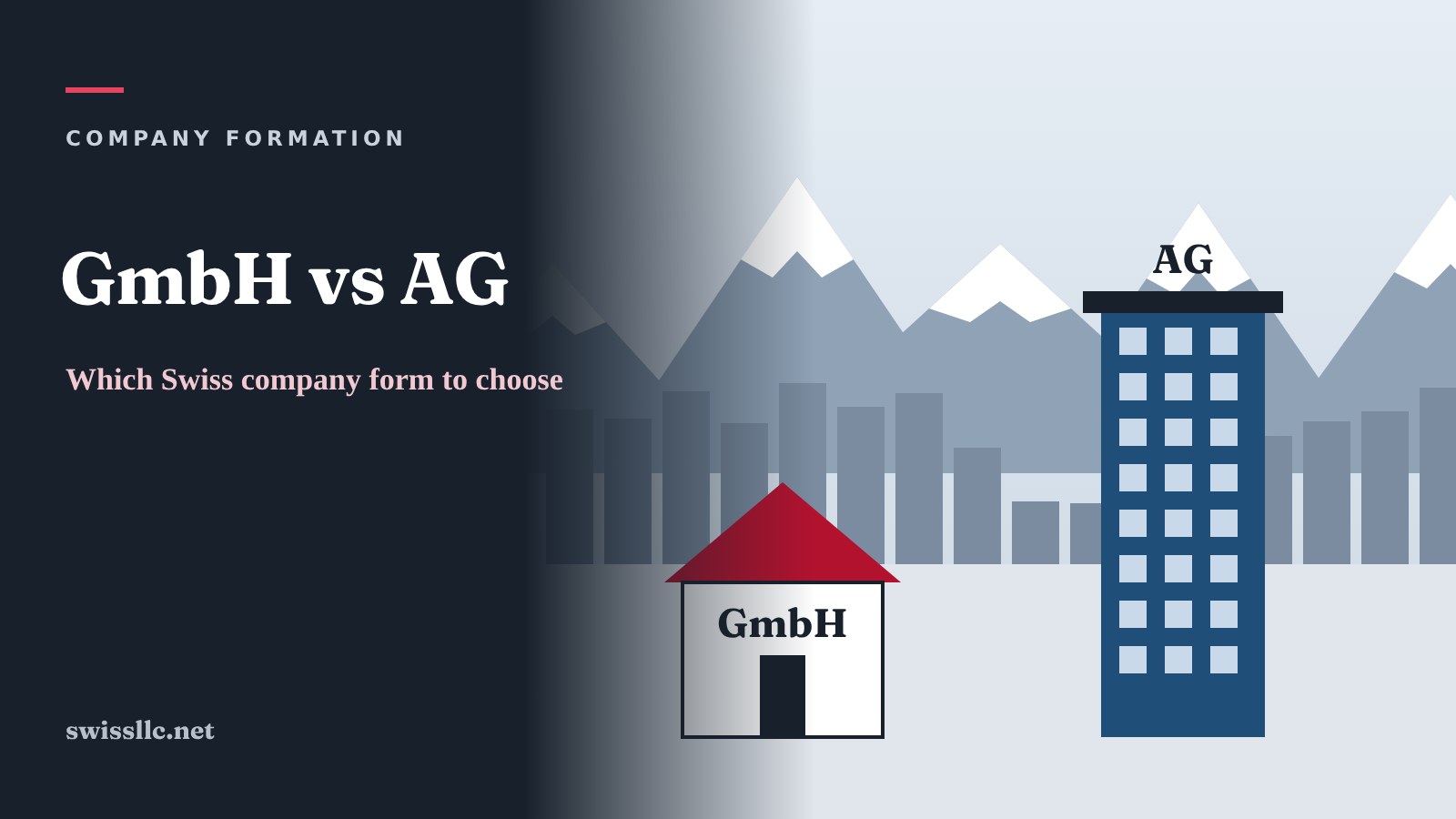
When founders in Switzerland want limited liability, they almost always end up choosing between two company forms: the GmbH (limited liability company, Sàrl in French) and the AG (company limited by shares, SA in French). Both are separate legal entities, both protect your personal assets, and both are taxed in the same way. The differences lie in capital, privacy, flexibility and how the company is perceived.
The short answer
- Choose a GmbH if you are a small or medium business, want to start with less capital and are happy for owners to be publicly listed.
- Choose an AG if you plan to raise investment, bring in many shareholders, want shareholders to stay out of the public register, or want the most established corporate image.
The details below explain why.
Share capital
| GmbH | AG | |
|---|---|---|
| Minimum capital | CHF 20,000 | CHF 100,000 |
| Paid in at formation | All of it | At least CHF 50,000 |
| Foreign currency allowed | Yes (EUR, USD, GBP, JPY) | Yes (same currencies) |
The GmbH needs less money up front. For an AG, the full CHF 100,000 must be subscribed, but only part of it has to be paid in at the start. In both cases the money goes into a special capital deposit account before the notary appointment, and it belongs to the company afterwards.
Privacy of owners
This is often the deciding factor.
- In a GmbH, the shareholders and their shares are entered in the commercial register, which anyone can search online.
- In an AG, shareholders are not listed in the commercial register. Only the board members and authorised signatories appear there. The company keeps its own share register.
Both company types must still keep a register of beneficial owners, and the authorities can see who stands behind a company.
Transferring shares
Selling or transferring a stake is easier in an AG. Shares can be transferred without a notary, and the articles can make them freely transferable.
In a GmbH, transferring a share requires a written contract and, unless the articles say otherwise, the approval of the shareholders' meeting. This makes a GmbH well suited to small groups of partners who want to control who joins.
Management and governance
- A GmbH is run by its managing directors (Geschäftsführer). By default, all shareholders manage the company together, but the articles can name specific managers.
- An AG is run by a board of directors (Verwaltungsrat), which can delegate day-to-day management to executives.
Either way, the company needs at least one authorised representative with a Swiss address. If you live abroad, the foreign founders guide covers your options.
Small companies of either type can skip the audit (an "opting-out") when they employ fewer than ten people full-time on average over the year and every shareholder consents.
Liability
Whichever form you pick, creditors can only claim against the company's assets, so shareholders usually stand to lose no more than the capital they invested. A GmbH's articles can add extra payment obligations for shareholders, but these are limited by law. In practice, directors of either form can become personally liable if they breach their duties, for example by failing to pay social insurance contributions.
Taxes
There is no tax difference between a GmbH and an AG. Both pay federal, cantonal and communal tax on profits and on capital. What matters much more is the canton you choose, as explained in our guide to corporate tax in Switzerland. Dividends to shareholders are taxed in the same way.
Costs and paperwork
Founding either company requires a notarised public deed and an entry in the commercial register. The federal KMU portal notes that founding a GmbH is generally a little cheaper than founding an AG. Running costs are similar: bookkeeping, annual accounts, a tax return and, if you have staff, social insurance.
Image
The AG is the classic form for larger companies, banks and businesses seeking investors, and some partners see it as more prestigious. The GmbH is extremely common and fully respected, particularly for small firms, consultancies, shops and start-ups. For most customers, either is perfectly professional.
Can you switch later?
Yes. A GmbH can be converted into an AG (and vice versa) under the Swiss Merger Act without dissolving the company. Many founders start as a GmbH and convert when they bring in investors.
Why it matters
Choosing the right legal form affects how much money you need at the start, how private your ownership is and how easily you can bring in partners. For most small businesses, a GmbH is the practical starting point. For investor-backed or larger ventures, the AG is often worth the extra capital.
If you will work alone and keep turnover low, compare both with a simple sole proprietorship. For a decision with long-term consequences, speak to a Swiss notary or fiduciary.
Further reading
- KMU portal of the Swiss Confederation — GmbH: liability, share capital, formation
- PostFinance — Founding an AG in Switzerland
- KMU portal — Legal forms comparison table
- Swiss Code of Obligations (OR), Articles 620–763 and 772–827