Swiss VAT Explained: Registration Threshold, Rates and Filing
When does a business in Switzerland have to register for VAT? A plain-English guide to the CHF 100,000 threshold, the 8.1% rate, filing periods and the net tax rate method.
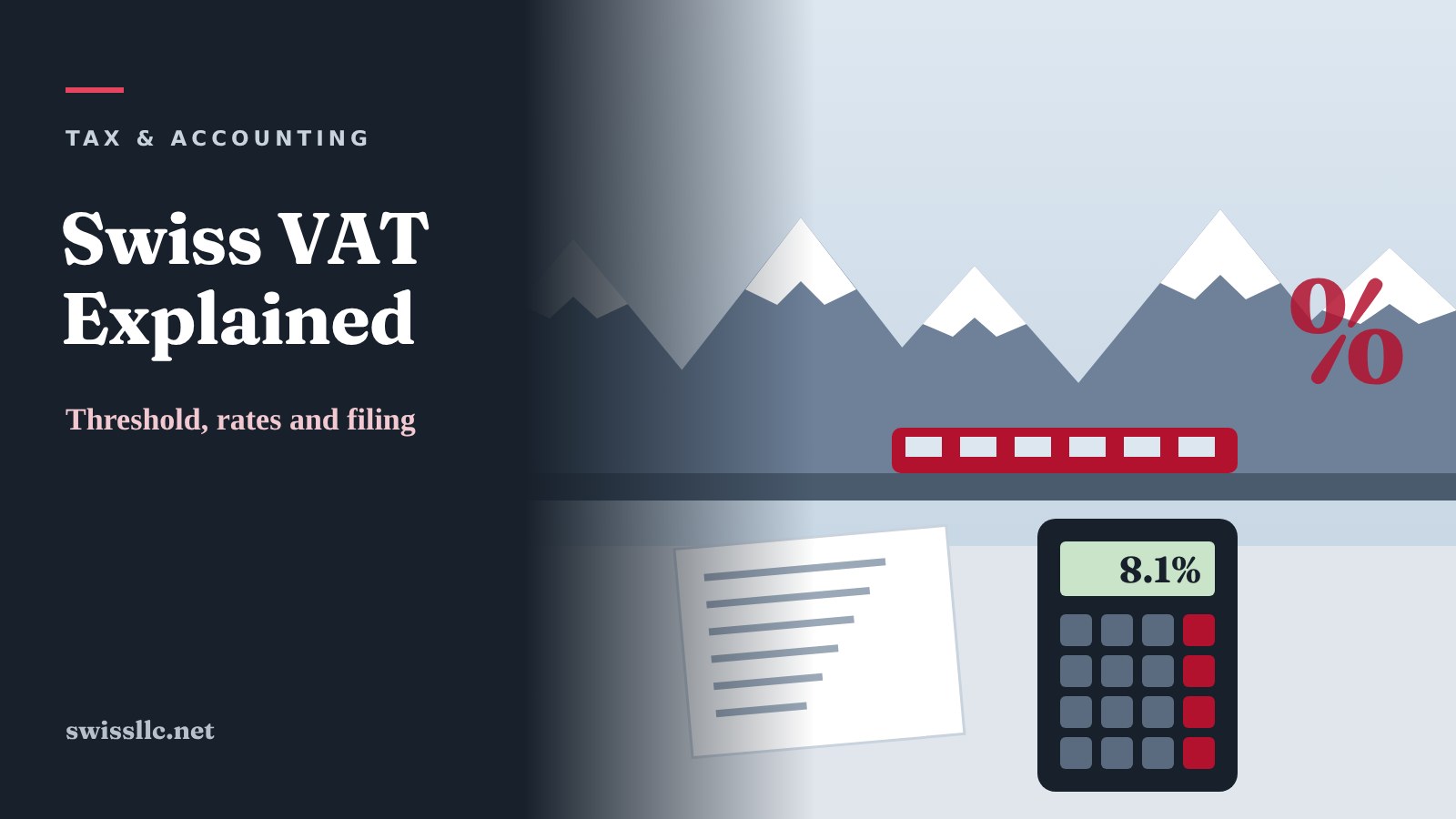
Value added tax (VAT), called Mehrwertsteuer (MWST) in German and TVA in French, is charged on most goods and services sold in Switzerland. Compared with its European neighbours, Switzerland's VAT rates are low, but the rules on who must register still catch many new businesses by surprise.
This guide explains when you must register, which rates apply and how filing works. It is general information; the Federal Tax Administration (ESTV) has the final word.
The current VAT rates
Since 1 January 2024, Switzerland has three VAT rates:
- 8.1% standard rate, for most goods and services;
- 2.6% reduced rate, for everyday necessities such as food, non-alcoholic drinks, books, newspapers and medicines;
- 3.8% special rate for accommodation, such as hotel stays.
Some activities are exempt from VAT, including many healthcare, education, insurance, banking and residential rental services. Exempt supplies are not taxed, but businesses making them generally cannot reclaim the VAT they pay on their own costs.
Who must register?
A business must register for VAT if its taxable turnover reaches CHF 100,000 a year. Importantly, the threshold counts worldwide turnover from taxable supplies, not only sales in Switzerland.
This applies to every legal form: sole proprietorships, GmbHs, AGs and partnerships alike. New businesses should estimate their turnover for the first twelve months; if it is likely to exceed the threshold, they register from the start.
Foreign businesses
Companies based abroad that provide goods or services in Switzerland may also have to register. According to the federal KMU portal, foreign businesses supplying services in Switzerland are liable for Swiss VAT unless their total annual taxable turnover, in Switzerland and abroad, is below CHF 100,000. Foreign businesses without a Swiss address must appoint a tax representative in Switzerland.
Since 2025, online platforms that enable sales of goods by third-party sellers to Swiss customers can themselves be treated as the supplier for VAT purposes.
Voluntary registration
Businesses below the threshold can choose to register. This lets them reclaim input VAT on purchases, which can make sense for start-ups with high initial investments. Voluntary registration applies for at least one full tax period, so check the conditions before applying.
How to register
Registration is done online with the Federal Tax Administration, either directly through its ePortal or through the government's EasyGov.swiss portal. You will need details of your business, its activities and its expected turnover. Once registered, you receive a VAT number based on your company's identification number (UID), followed by "MWST", "TVA" or "IVA".
You must then show VAT correctly on your invoices: your VAT number, the rate and the amount of tax.
Two ways to calculate VAT
The effective method
Under the effective method, you charge VAT on your sales and deduct the VAT you paid on business purchases (input tax). You pay the difference to the ESTV. This method suits businesses with large purchases or investments. Returns are normally filed quarterly.
The net tax rate method
Smaller businesses can choose the net tax rate method (Saldosteuersatz). You still charge customers the normal VAT, but you pay the ESTV a fixed, lower percentage of your gross turnover set for your industry, and you do not deduct input tax. It is available to businesses whose annual turnover and tax liability stay below limits set by the ESTV. Returns are filed every six months.
The net tax rate method greatly reduces paperwork, but it can cost more if you have high input costs. Your fiduciary can help you compare the two.
Since 2025, VAT returns must be filed electronically.
VAT and your business structure
Whether you trade as a sole proprietor or through a company, the VAT rules are the same. If you set up a GmbH or are still choosing between a GmbH and an AG, plan your VAT registration as part of the formation. And keep the VAT you collect in your business bank account: it belongs to the tax authority, not to you.
Deadlines and payments
VAT returns and payments are due 60 days after the end of each period. Late payment attracts interest. Keep all invoices and VAT records; Swiss law requires business records to be kept for ten years.
Exports and imports
Exports of goods abroad are generally zero-rated, as long as you can prove the goods left Switzerland. Imports are subject to import VAT, collected by the Federal Office for Customs and Border Security when goods cross the border.
Switzerland is not part of the EU VAT system, so EU rules such as the EU reverse-charge mechanism and VIES numbers do not apply in the same way.
Common mistakes
- forgetting that the CHF 100,000 threshold includes turnover earned abroad;
- registering late and having to pay VAT that was never charged to customers;
- missing VAT details on invoices;
- choosing the net tax rate method without checking whether it suits your costs.
The ESTV explains recent changes, including the platform rules, on its page about the partial revision of the VAT Act.
Why it matters
VAT is one of the first official obligations a growing business meets. Registering on time, invoicing correctly and choosing the right calculation method keep cash flow predictable and avoid penalties.
VAT also interacts with your other taxes. Read our overview of corporate tax in Switzerland, and if you are preparing your first year, our guide to running payroll and social insurance. For your specific case, a Swiss fiduciary or tax adviser can confirm the details.
Further reading
- Federal Tax Administration (ESTV) — Partial revision of the VAT Act
- Canton of Zurich — Forming a GmbH (VAT liability)
- KMU portal — Nationals from EU/EFTA member states
- Federal Act on Value Added Tax (VAT Act, MWSTG)